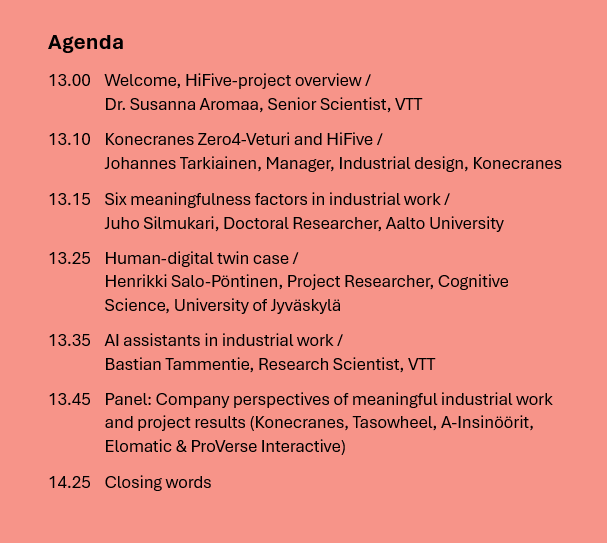
Final webinar in March, 2026
Meaningful industrial work in hybrid human-technology-AI teams
BF-HiFive-project final webinar – key results and insights
Welcome to the “HiFive project final webinar”, where we will present the main outcomes and insights from the HiFive project. During the webinar, we will share key findings related to meaningfulness in industrial work, and discuss how emerging technologies such as AI assistants are shaping the future of work in manufacturing. This webinar is a great opportunity to hear about the project results, exchange perspectives, and reflect on the transition toward more advanced digitalisation and automation, with an increasing focus on human-centric approaches.
Date & Time: 19.3.2026, 13.00 – 14.30 (GMT+2)
Location: Online / MS Teams
We warmly welcome researchers, industry professionals, and all stakeholders interested in the future of industrial work and human-centered Industry 5.0 development.
Kind regards,
HiFive-project team
Research exchange in October, 2025
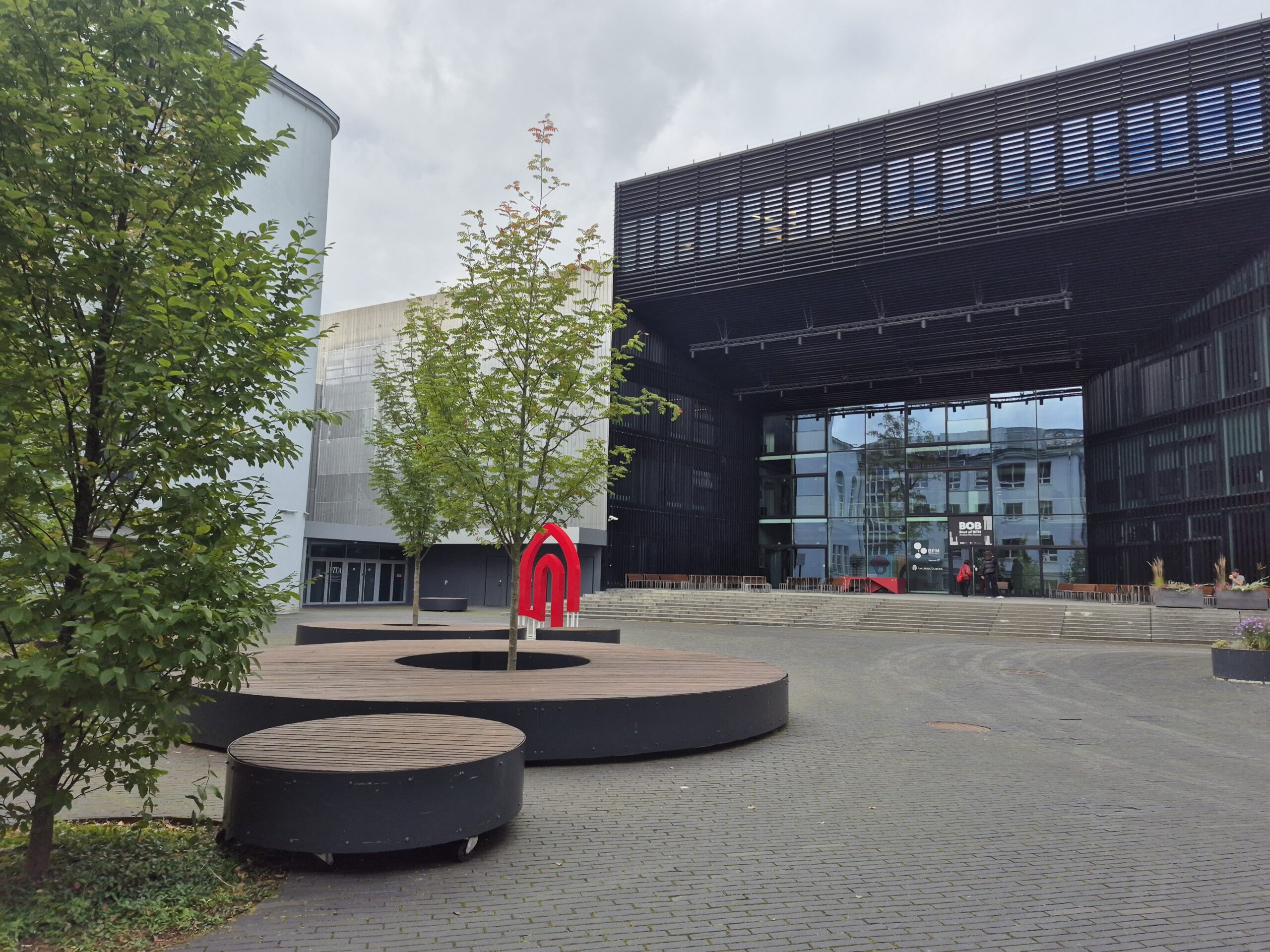
In October 2025, project researcher Bastian completed a productive one-month research exchange at Tallinn University’s School of Digital Technologies in Estonia. During this time, Bastian focused on writing an article about the project’s main results, concentrating on designing human-centric, resilient industrial systems and fostering collaboration. He worked closely with PhD researchers in Tallinn University’s Transform project, developing workshop plans and sharing collaborative practices, leading to future joint research and planned workshops between Tallinn University and VTT.
The exchange also included attending an accessibility workshop organized by Tampere University, where participants brainstormed solutions to improve accessibility for diverse needs. This experience highlighted how inclusive design benefits both people and advances innovation in collaborative robotics.
Bastian also attended the European Conference on Cognitive Ergonomics (ECCE 2025), connecting with experts in human factors and cognitive ergonomics. The project team is grateful to Tallinn University for opening new avenues for international collaboration and contributing valuable perspectives to the mission of creating advanced, human-centric industrial work solutions.
Zero4 Symposium in October, 2025
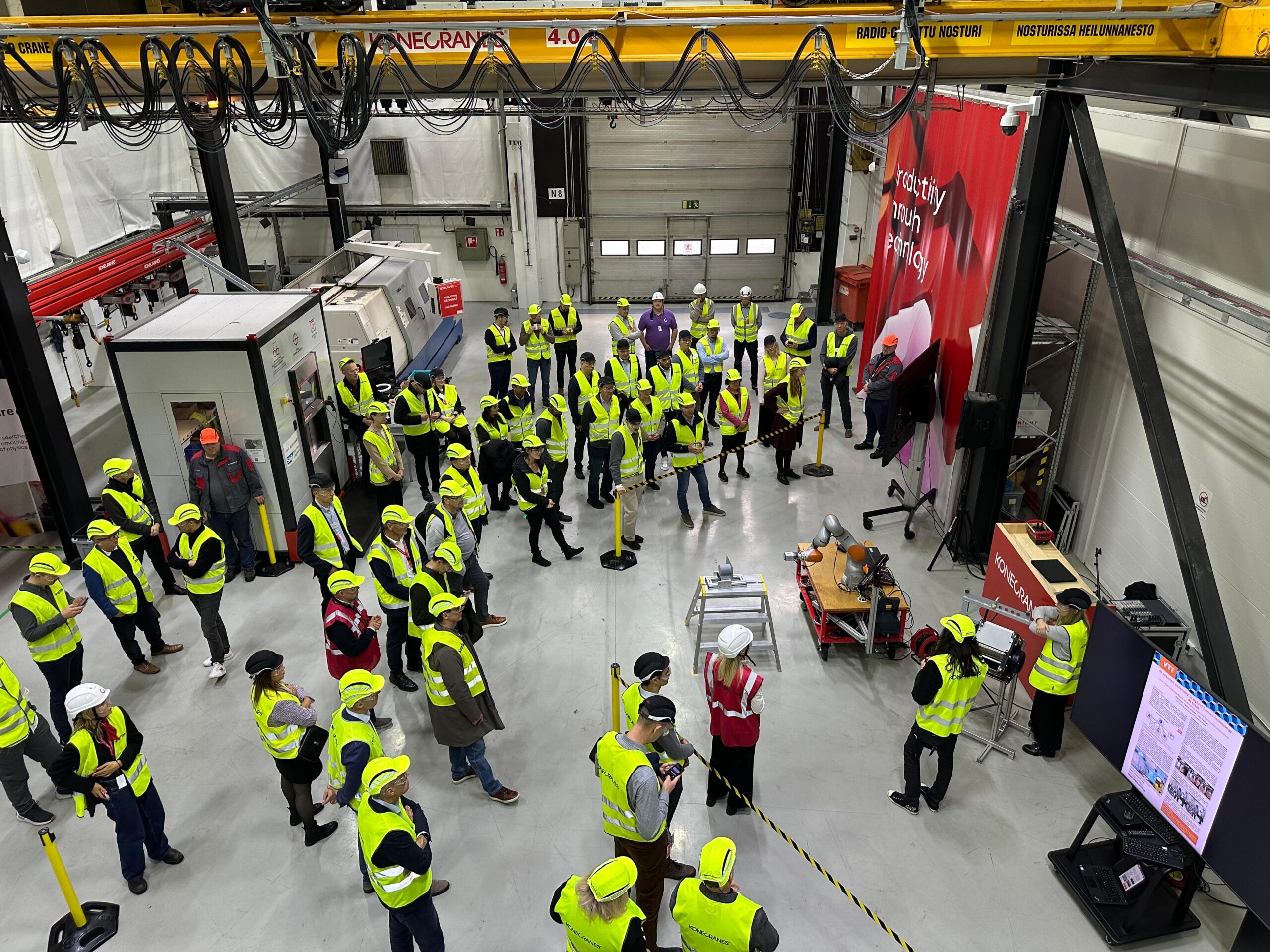
The HiFive project participated in the Zero4 symposium organised at Konecranes by presenting the project in general and sharing research results in three research presentations and two posters. The day was interesting thanks to the presentations, demonstrations, and discussions.
- Meaningfulness of work and Industry 5.0: transition, design and opportunities, Juho Silmukari (Aalto/Konecranes)
- Content-based thinking in renewing design, Mari Myllylä (JyU)
- Supporting knowledge sharing in factory work through technology, Antti Tammela (VTT)
- Future business concepts and models for the industrial metaverse, Matias Vierimaa (VTT)
- AI assisted assembly in hybrid human-technology-AI teams – Local large language model (LLM) for guidance, instructions and safety observations, Taru Hakanen ja Vladimir Goriachev (VTT)
Demonstration in June, 2025
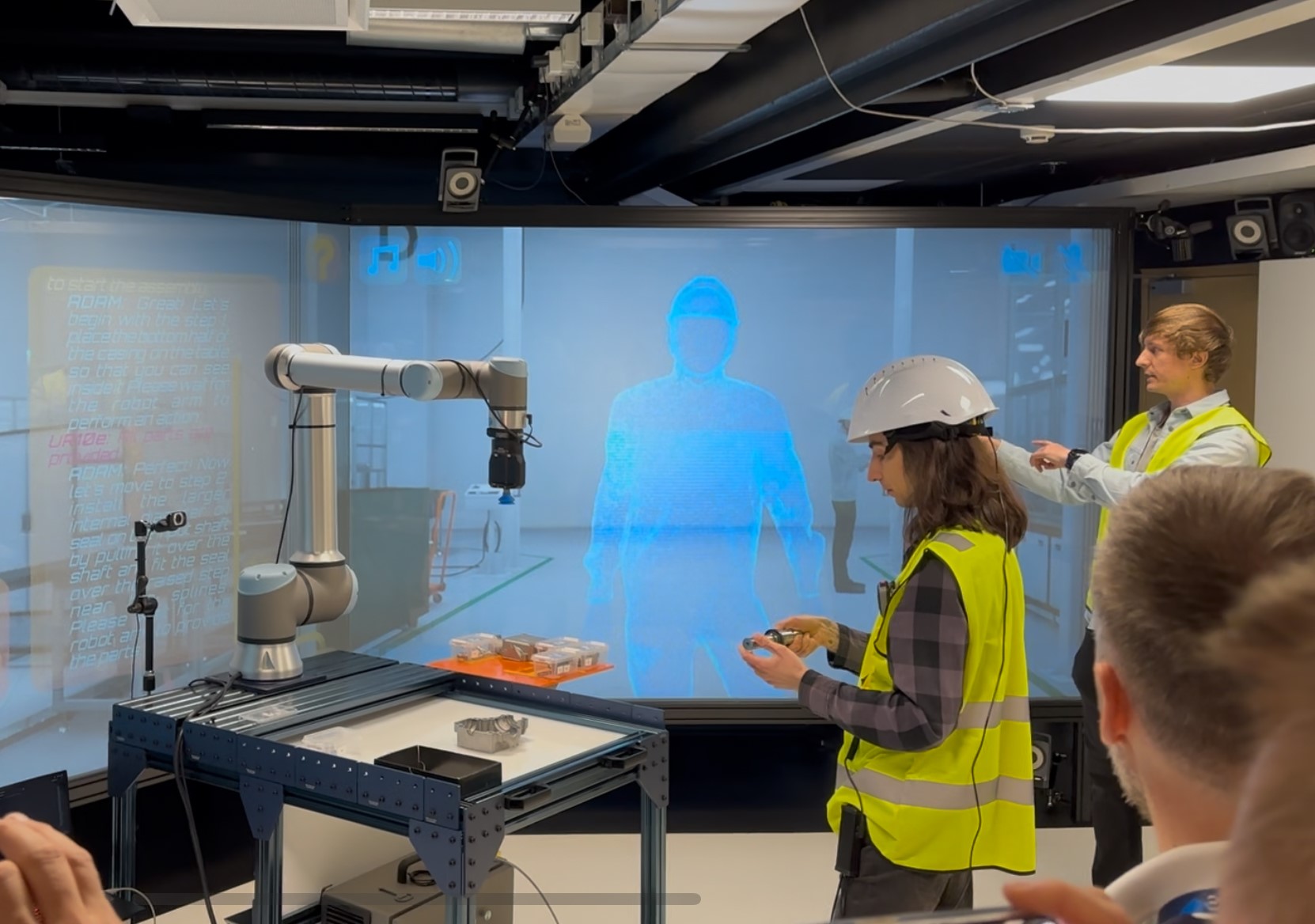
VTT showcased a proof-of-concept for an “AI-enhanced assistant designed to support assembly workers” to project partners. This demonstration illustrated how AI can assist an assembly worker while they collaborate with a cobot on a product assembly task. In the setup, the worker wore a helmet equipped with a camera, which could capture images and videos for the AI assistant. Both the worker and cobot, in turn, received instructions from the AI system.
The demonstration utilised local AI system in various scenarios, including handling images, video, and text. Speech and visual data were converted into text for the AI assistant, which interpreted the input based on the given context. Additionally, advanced safety measures were integrated, such as a camera able to monitor the number of people in the workspace for AI to verify if they were wearing proper safety gear, including vests and helmets.
Though the local AI system experienced some delays in response time due to computational power, the project partners still found the demonstration intriguing and promising.
See a video of the demo: https://www.youtube.com/watch?v=JbdQ5BNxUQA
Roundtable discussion in May2025
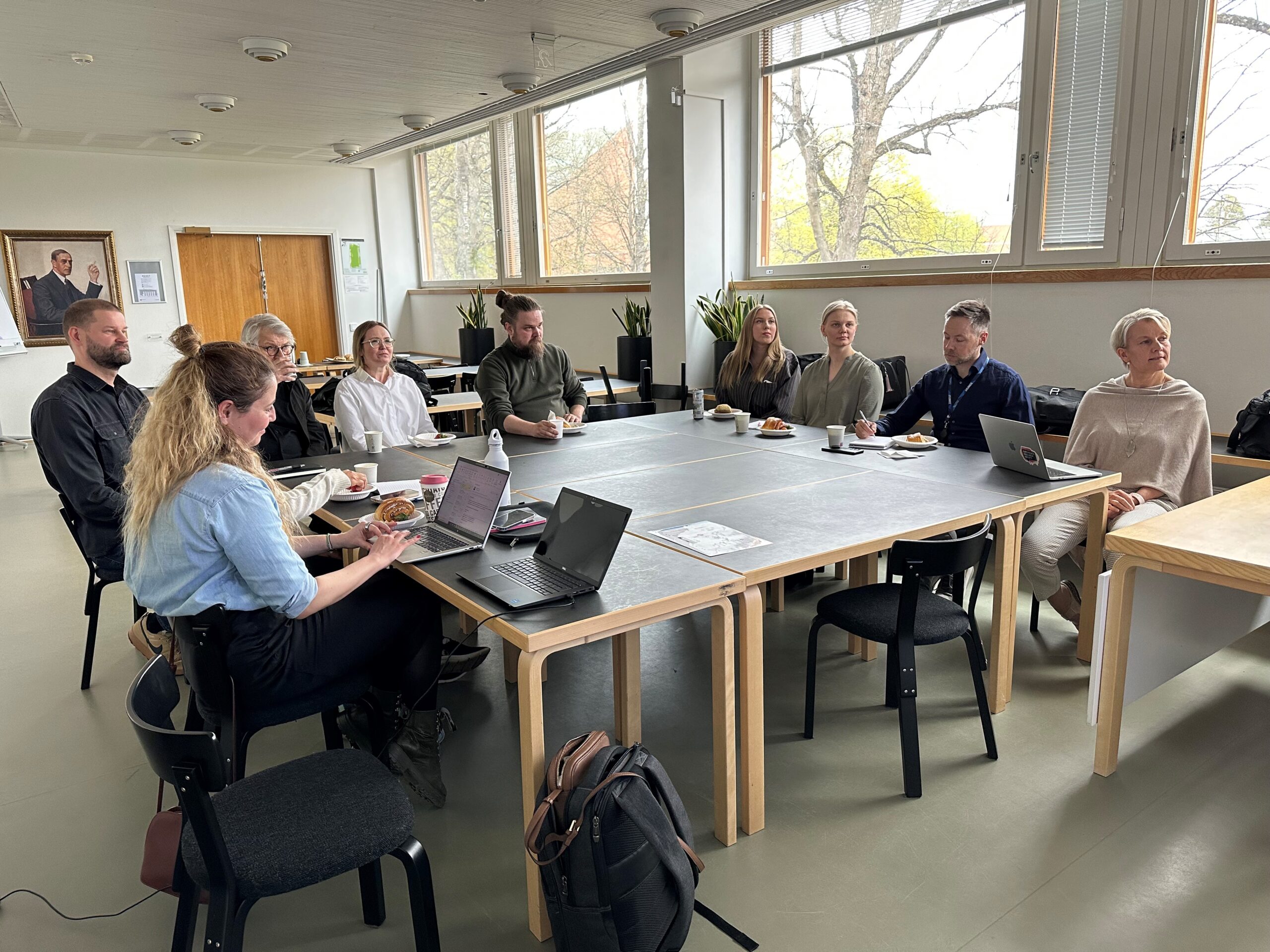
Vera Liao from Microsoft visited Aalto in May to have a lecture about artificial intelligence: “Human-Centered AI Transparency: Bridging the Sociotechnical Gap”. During the visit, she participated in the HiFive consortium discussion on the theme of AI in industry. The discussion was based on questions formulated by JyU about workers’ tacit knowledge and AI in industrial work, AI concepts for crane use created by Aalto students, and VTT’s demo of an AI assistant for a crane lifting task.
The conversation was lively, and two hours passed quickly. Discussion topics included workers’ tacit knowledge and how to make it more visible. Who owns the knowledge: the employee or the company? Could AI help make tacit knowledge more visible? Additionally, the roles of humans and AI in work tasks were considered. The presented concepts and demo were also interesting and sparked discussion. For example, the AI’s voice interface received skeptical comments about its slow response time and long sentences.
User studies in May, 2025
One objective of the HiFive project is to assess the impact of novel technologies on industrial work, including evaluating employees’ perceptions of any benefits derived from utilising these technologies.
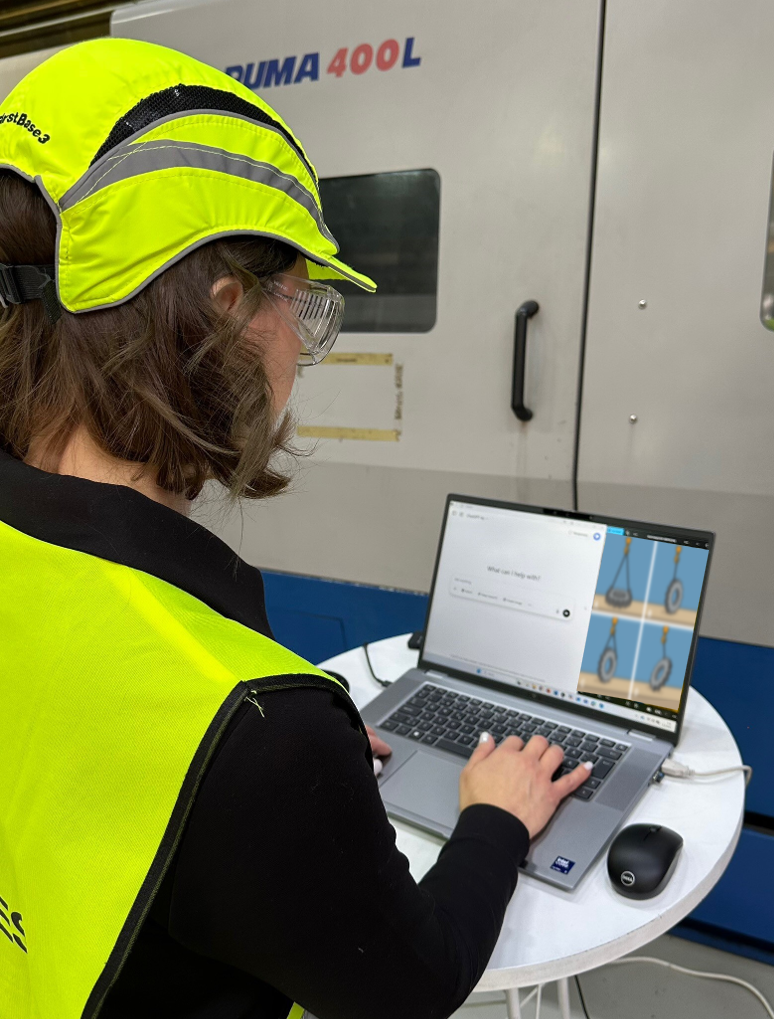
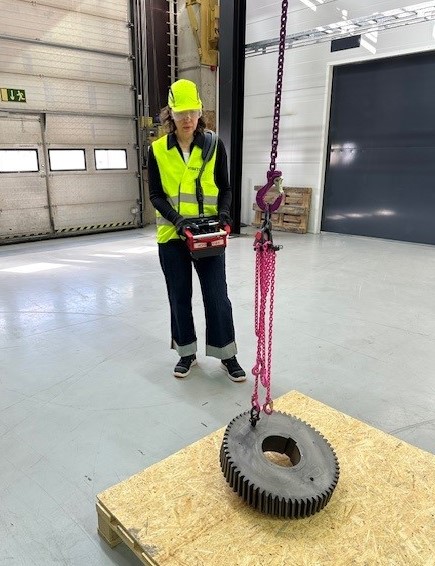
VTT researchers spent two days in the wild at Konecranes premises in Hyvinkää. They conducted user tests and interviewed factory workers to hear their thoughts on how an AI assistant and remote expert via smart glasses could support their daily tasks. It was insightful to see these technologies in action during a real industrial activity — turning a gearwheel with a crane. Participation of end users is important when designing novel technologies. The initial experiences of both proof-of-concepts were positive, and there is a sense of potential for future applications in factory work.
Face-to-face workshop in April 2025
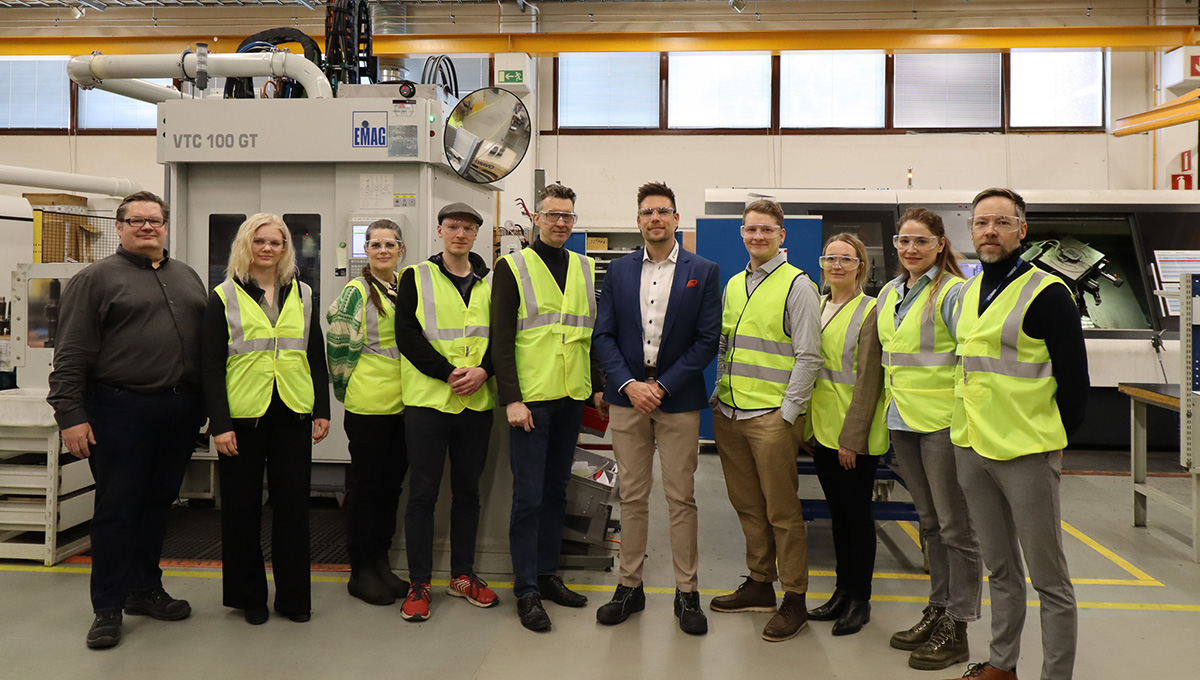
The consortium members met at the Tasowheel factory in Tampere. The agenda of the day included a visit to the factory and discussions about the project topics. After an engaging factory tour, the consortium members participated in a workshop where they divided into groups to discuss four key themes:
- Meaningful future (hybrid) ways of working
- Human-AI teaming assessment method
- Designing intelligent work systems and Human Digital Twins
- Business vision and targets for meaningful industrial work in hybrid human-technology-AI teams
Research exchange on March, 2025
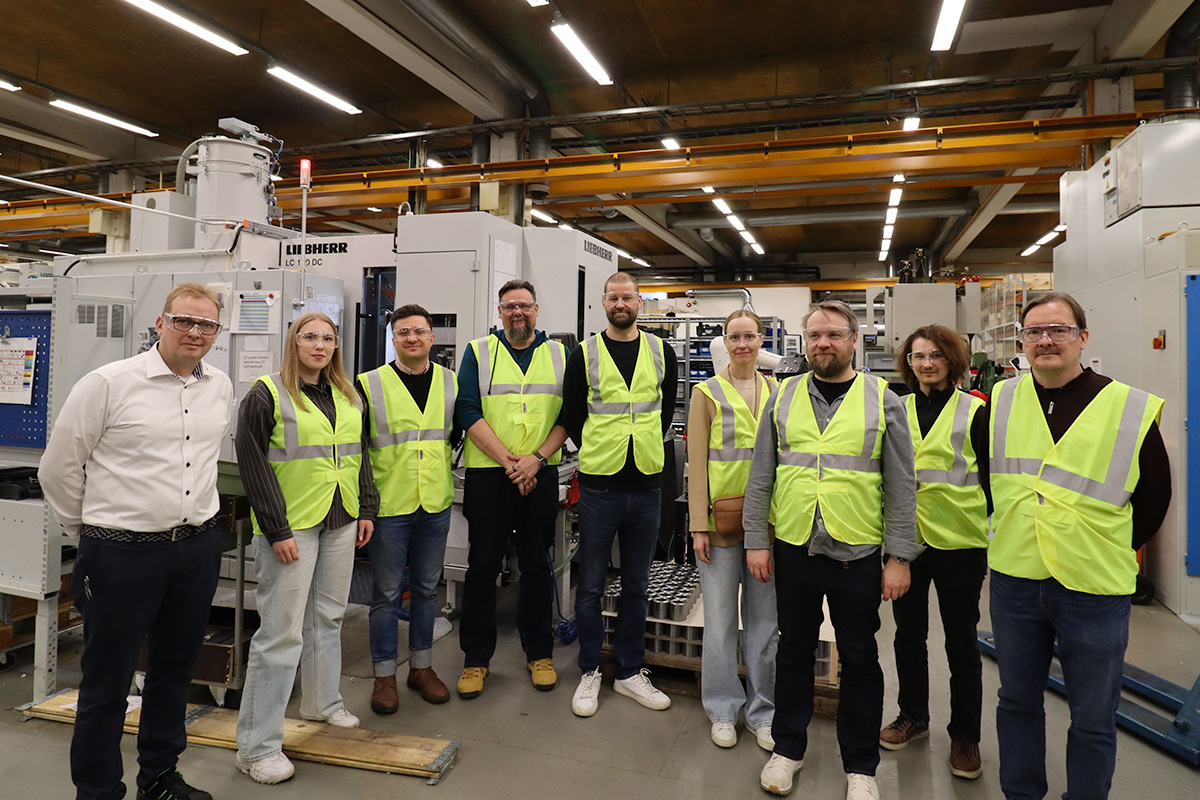
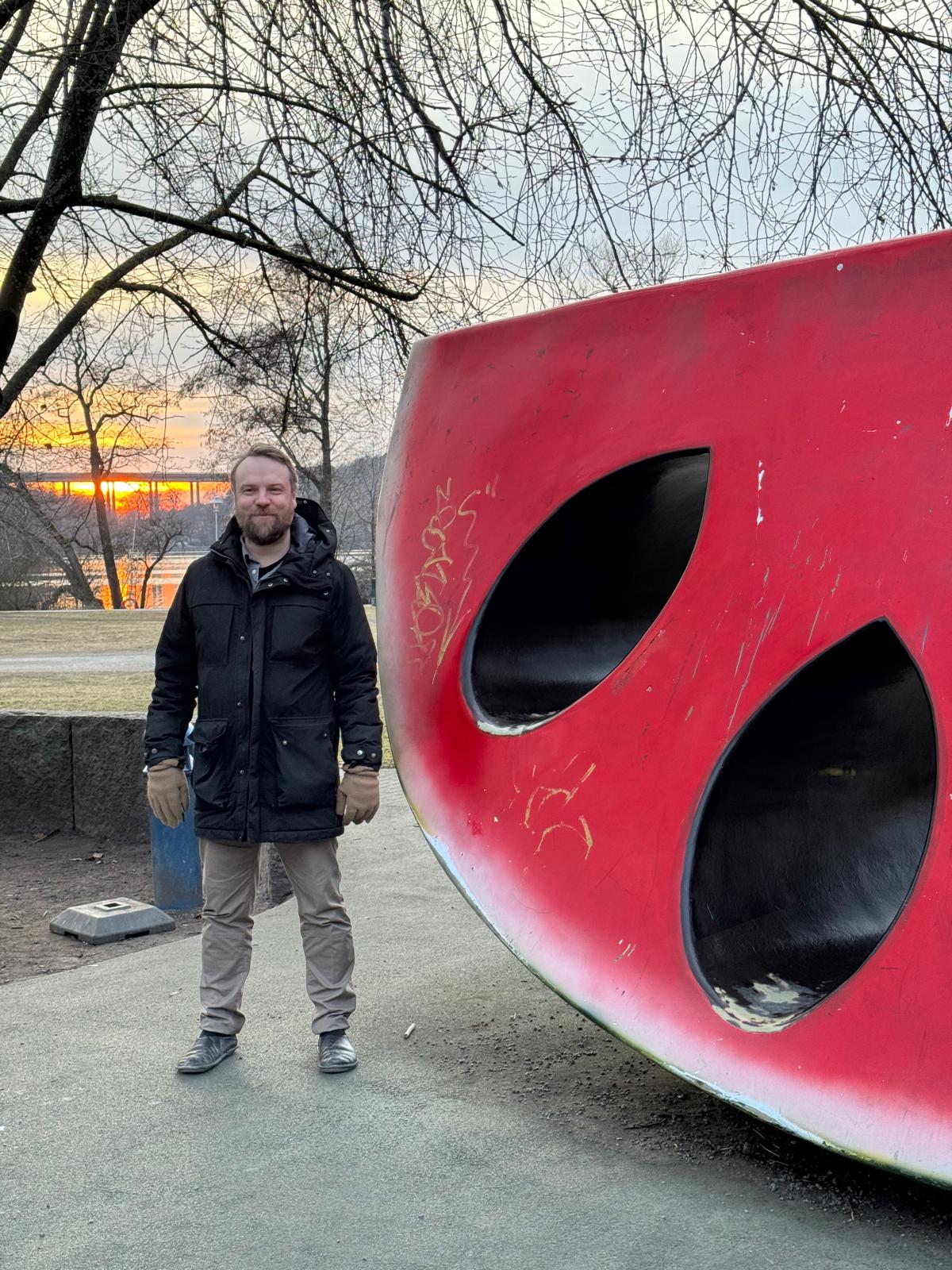
The first international scientific exchange within HiFive has taken place: Mikael Wahlström from VTT visited the Stockholm Technology & Interaction Research (STIR) group at Stockholm University.
“Although not focused on industrial contexts, they at STIR are also interested in how AI will change work, just as we are at HiFive project,” says Mikael.
During the visit, Mikael held a seminar, discussed with various researchers and participated in workshops.
“The visit both confirmed and broadened my thinking about both concerns and how to positively influence the future of work,” he continues.
Doctoral students in the project, February 2025
Two doctoral students are participating in the project. Here are brief introductions to their research themes.
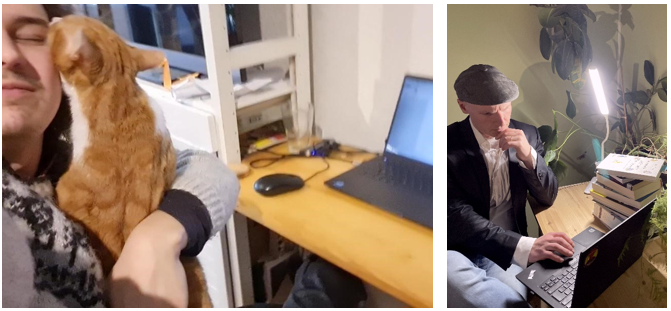
Bastian is a research scientist in the Human factors and system safety team at VTT and a doctoral student at Tampere University at the faculty of Social Sciences. His thesis is about the dimensions of human agency in complex systems, focusing on industrial manufacturing and the implementation of intelligent technologies and automation. The chief supervisor of his work is his cat Rimpularontti.
Juho is a student in Aalto University Department of Design and his doctoral thesis is about meaningfulness of work in manufacturing industry. His work concentrates on bringing new knowledge about emergence of hybrid technologies and future ways of working in industrial factories, with strong emphasis on user-centricity and design perspective.
Face-to-face workshop on December, 2024
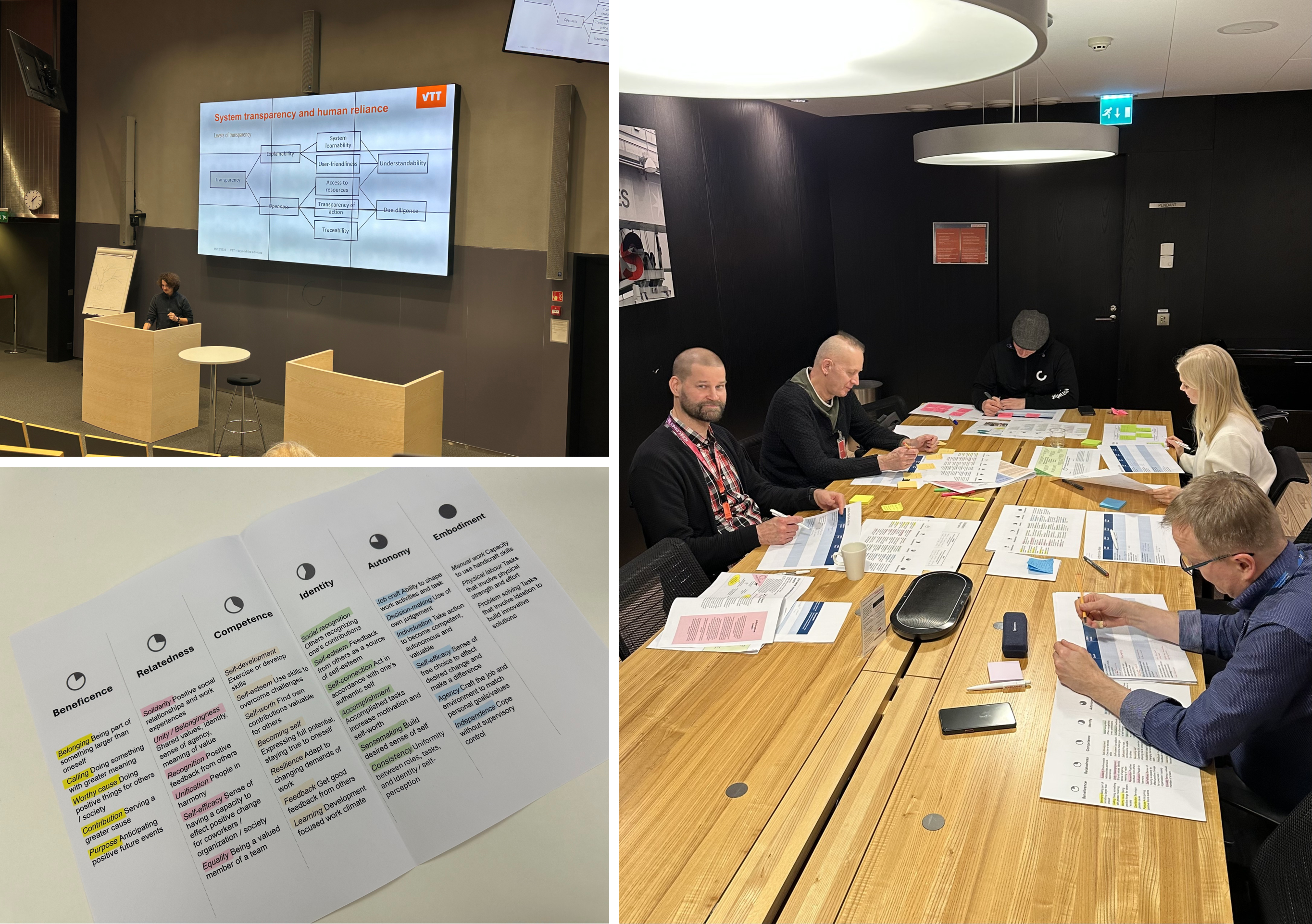
The second face-to-face meeting was held at Konecranes’ premises in December. The day was full of interesting programs and discussions. During the factory tour, we got to know the manufacturing of cranes and factory work in general. In the afternoon there were interesting presentations, for example, about tacit knowledge, human digital twins, system transparency and human reliance. In addition, the preliminary findings from interviews with factory workers were presented. They were related to themes such as information access, learning, collaboration and systems’ usability and reliability. In addition, the collaborative workshops provided an opportunity to discuss issues related to the meaningfulness of work and the utilisation of new technologies. These discussions were based on practical work examples of assembly, re-manufacturing and material handling tasks derived from the interviews.
Presentation in ISM conference on November, 2024
Susanna Aromaa took part to the International Conference on Industry 4.0 and Smart Manufacturing which was held in Prague, 20-22 November 2024 (ISM 2024). She presented the paper called “Company perspectives of generative artificial intelligence in industrial work”. There were many interesting presentations at the conference, and the themes were broadly related to the industry of the future, for example, smart manufacturing, AI, robotics, digital twins, supply chains, human factors, education, etc. Many times during the conference, the discussion returned to the themes of Industry 5.0 (human centricity, resilience and sustainability) and their importance on the industry of the future.
Interviews has been started on October, 2024
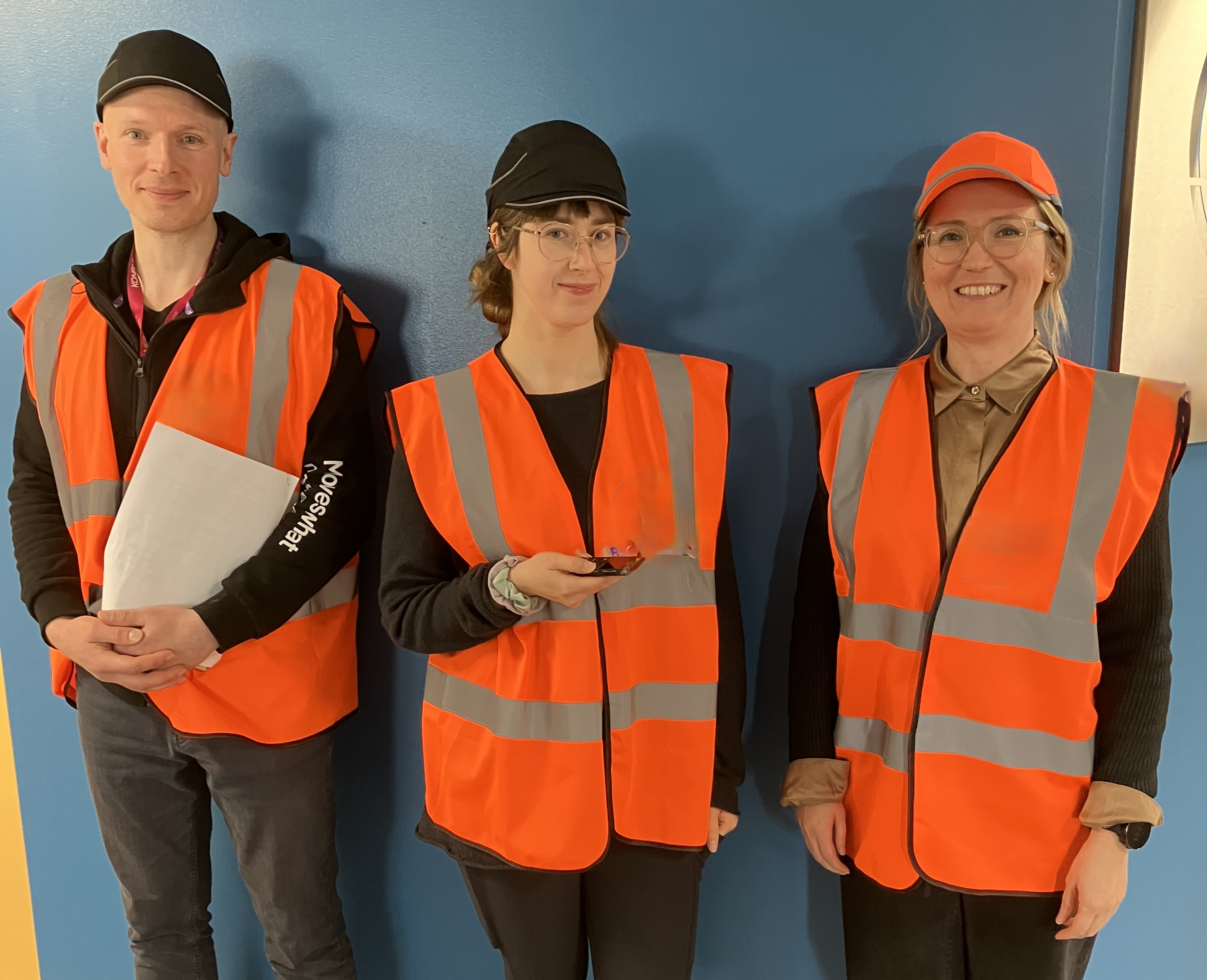
The project has got off to a fast start by interviewing and observing factory floor workers in industrial companies. The aim of the interviews is to understand the current work tasks and the challenges they present. In addition, employees are asked about the meaningfulness of work. Three companies have already been visited and the goal is to get closer to ten visits. The picture shows few people from our top research team.
The first project news has been published on October, 2024
Business Finland funded joint development project “Meaningful industrial work in hybrid human-technology-AI teams” (HiFive) has kicked off…